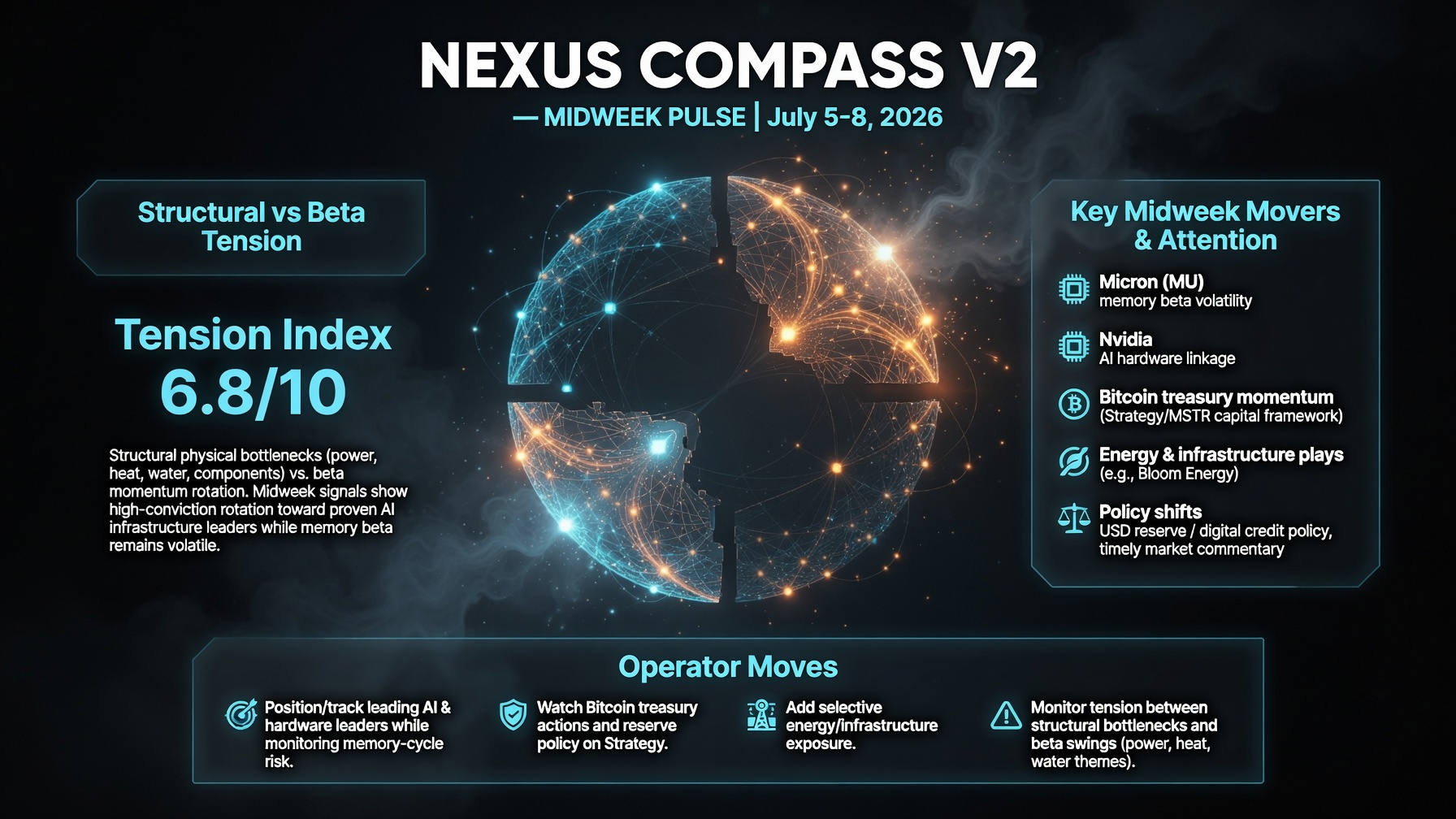
Four domains — energy, compute, AI, and crypto — are converging into a single infrastructure stack. This isn't a prediction. It's already happening. The evidence is accumulating in earnings calls, regulatory filings, power purchase agreements, and protocol upgrades. The question isn't whether these domains merge, but how fast capital recognizes the merge and repositions accordingly.
For decades, these sectors operated on parallel tracks. Energy companies powered grids. Chip manufacturers served enterprise IT. AI was an academic curiosity. Crypto was a fringe experiment. Each had its own capital structure, its own investor base, its own logic. That separation is ending.
The catalyst is simple: AI models require exponentially more compute, which requires exponentially more energy. This isn't a linear growth curve — it's a step function. Every new frontier model demands more GPUs, more data center capacity, more megawatts. The compute buildout underway today dwarfs anything the tech industry has ever attempted, and the energy demands are rewriting the assumptions of every utility planning model in the country.
Bitcoin is emerging as the base-layer reserve asset for a new financial system built on abundant energy, scaled compute, and autonomous AI agents.
That's the thesis in one sentence. Here's how the pieces connect.
- The compute hunger is real and accelerating. Training GPT-4 required an estimated 25,000 GPUs running for months. The next generation of models will demand orders of magnitude more. Every major tech company is now in an arms race for compute, and compute is just a proxy for energy. Whoever controls the cheapest, most reliable energy wins the AI race.
- The energy bottleneck is being solved by a nuclear renaissance. Natural gas can't scale fast enough. Renewables are intermittent. The answer is nuclear — specifically, small modular reactors and advanced reactor designs that can be deployed at data center scale. The NRC licensing pipeline is the most active it's been in decades. Microsoft, Google, and Amazon have all signed nuclear power agreements. This isn't speculative. The contracts are signed.
- Bitcoin miners already solved the hard problem. They figured out how to secure cheap, abundant power at scale — in remote locations, with flexible load profiles, often using stranded or curtailed energy. Now they're pivoting to high-performance compute. Companies like Core Scientific, Iris Energy, and TeraWulf aren't just mining Bitcoin anymore. They're becoming energy-compute infrastructure companies that serve both Bitcoin mining and AI inference workloads. The market is beginning to price this correctly.
- Autonomous AI agents need programmable money. As AI systems become more capable, they'll transact autonomously — purchasing compute, paying for data, settling micro-transactions with other agents. These agents can't open bank accounts. They can't wait for ACH settlements. They need programmable, permissionless money that settles in minutes, not days. This leads inevitably to crypto rails.
- Stablecoins are the onramp. Bitcoin is the destination. Stablecoins solve the payments problem — fast, cheap, global value transfer. But they're centralized IOUs backed by treasuries held in traditional banks. They inherit every risk of the legacy system they're trying to replace. Bitcoin solves the trust problem. No counterparty. No issuer. No single point of failure. Stablecoins move the money. Bitcoin stores the value.
Each of these trends is well-documented individually. The insight isn't that any single one matters — it's that they're the same trend, viewed from different angles. Energy abundance enables compute abundance, which enables AI abundance, which creates demand for trustless digital settlement. The convergence isn't a coincidence. It's structural.